
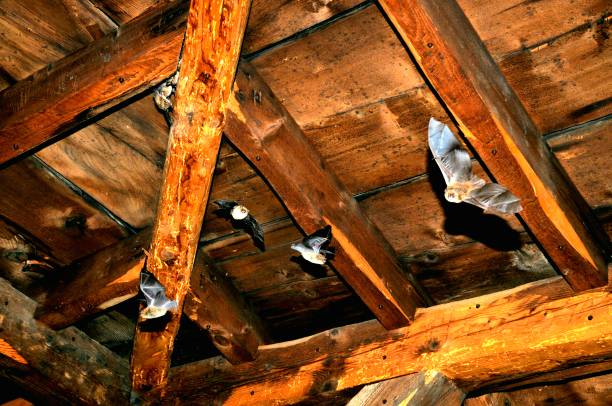
To get rid of bats in the attic, you let them leave and then make sure they can’t come back. That’s called exclusion. One-way devices go over the holes the bats use, the bats fly out to feed at night and can’t get back in, and then the openings get sealed. Timing is the part people miss: the New York State Department of Health says not to batproof buildings from late May to mid-August.
Here’s why. In those months, young bats can’t fly yet. Seal the attic then, or seal it before every bat is out, and bats die in your walls. Bats can carry rabies, and their droppings can carry a fungus that causes a lung infection, so this is a job to do carefully.
When to do it
The state health department’s guidance on bats (revised May 2001) gives late May to mid-August as the time to wait. The Internet Center for Wildlife Damage Management (ICWDM) gives a similar window, May 15 to August 15. Bat Conservation International is more careful still and says to avoid April through September in North America.
Exclusion also needs warm nights, when bats fly out to feed. So if you find bats in June, use the summer to find the openings and plan the work. Do the exclusion once the young can fly.
How to get bats out, step by step
- Make sure it’s bats. Look for droppings that crumble with shiny insect bits, greasy rub marks around small gaps, a musty smell, and noise at dusk and dawn, ICWDM says. Watch the building at dusk to see where they fly out.
- Find every opening. ICWDM says a small bat can fit through a gap 3/8 inch wide, about the width of a dime. Check rooflines, vents, chimneys and eaves.
- Put one-way devices over the holes bats use. ICWDM describes netting check-valves and one-way doors, left up for at least 3 to 5 days, and longer if it rains. Bat Conservation International prefers exclusion tubes left for at least 7 warm nights, and says not to use flexible netting or one-way doors.
- Close the other gaps. Seal the openings bats aren’t using so they can’t just switch doors. ICWDM says to seal gaps of 1/4 by 1 1/2 inches and openings of 5/8 by 7/8 inch or bigger.
- Seal for good. Once the bats are gone, take the devices down and seal those holes too. Bat Conservation International suggests water-based silicone caulk, hardware cloth or heavy-duty plastic mesh, and says not to use expandable foam.
- Clean up the droppings safely. Bat droppings can carry the fungus that causes histoplasmosis, a lung infection, the CDC says, so don’t sweep them up dry.
The sources disagree on which device to use, and that’s fine. What matters is that every bat can get out, none can get back in, and nothing gets sealed until they’re gone.
What not to do
- Don’t use poison. ICWDM says no toxicants are registered for controlling bats.
- Don’t try to trap and move the colony. DEC says to contact a DEC wildlife office or a licensed nuisance wildlife control operator when dealing with bats.
- Don’t treat them as pests to wipe out. Some New York bats, like the Indiana bat and the northern long-eared bat, are state and federally listed species, and DEC says white-nose syndrome has killed more than 90% of bats at hibernation sites in the state (DEC, October 2025).
If a bat gets into your living space
A bite from a bat can be small enough to miss. If a bat was in a room where someone was sleeping, or near a young child, NYC Health says to close the windows and doors so it can’t escape, then call 311 to have it collected and tested.
To catch it safely, the state health department’s bat tips (July 2025) say to turn on the lights, close the windows and the room and closet doors, and wait for the bat to land. Then put on gloves, cover it with a container, slide cardboard under it and tape it shut. If anyone may have had contact with it, don’t let the bat go.
A summer bat problem, start to finish
Here’s a simple example. Say a Queens homeowner sees bats flying out from under the roof edge at dusk in early July. It’s pup season, so sealing now would trap young bats inside. The right move is to find and note the openings now, keep the attic hatch shut, and plan the exclusion for after mid-August.
Then one-way devices go up over the active gaps and stay for several warm nights, and the openings get sealed once the bats are gone. The trade-off: six more weeks with bats overhead. It’s still better than dead bats and a bad smell in the walls.
How NYC Extermination removes bats
We start with a free on-site inspection to find where the bats roost and how they get in and out. Then we use exclusion, which lets the bats leave but not come back, and we seal the openings they used and the other gaps they could use. Timing matters in early summer, when young bats can’t fly yet, and exclusion and sealing can take more than one visit. If droppings have built up, we’ll tell you what your space needs after the inspection. In apartment buildings and businesses, we inspect the whole building and plan the work to keep disruption low.
See our bat removal service, our guide to signs of animals in the attic, or call (347) 988-2315.
Frequently asked questions
Can I just seal the holes while the bats are out at night?
Not safely. You can’t be sure every bat is out, and from late May to mid-August young bats that can’t fly yet stay in the roost. One-way devices let the bats leave on their own before anything gets sealed.
Do ultrasonic bat repellers work?
No. The CDC’s workplace safety institute, NIOSH, says ultrasonic devices and chemical repellents are not effective for getting rid of bats. Exclusion and sealing are what work.
Is it safe to clean up bat droppings myself?
Be careful. The CDC says large amounts of bird or bat droppings should be cleaned up by professional companies, because stirring them up can spread the fungus that causes histoplasmosis. For any amount, NIOSH advises against sweeping or shoveling dry, dusty droppings.
Will bats come back after they’re excluded?
They can if any openings are left. That’s why sealing is the last step, and why it covers every gap a bat could use, not only the ones they were using.

Recent Comments