
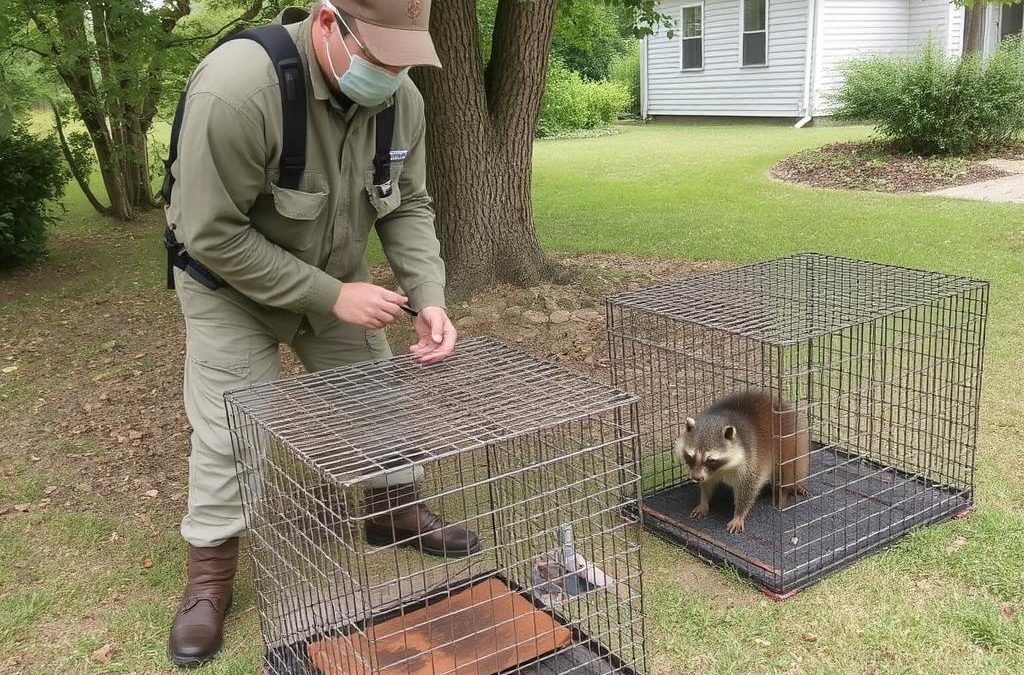
A small animal trap is a live cage trap sized for squirrels, chipmunks, opossums, skunks and similar animals. Whether you should use one depends on the animal. In New York, some can be trapped without a permit and some can’t, and none can be moved off your property. Here’s what to do for each one.
Start with the state’s own advice. The New York State DEC says taking an animal is only suggested if other best practices don’t fix the problem, and that it’s illegal for you to relocate an animal off your property.
Quick guide
| Animal | Can a homeowner take it without a permit? | First step |
|---|---|---|
| Chipmunk | Yes | Close gaps with 1/4-inch hardware cloth |
| Red squirrel | Yes | Find and seal the way in |
| Gray squirrel | Only if it’s damaging property | Check for babies, then evict |
| Opossum | Only if it’s damaging property | Take away food and close openings |
| Skunk | Yes | Make sure no young are inside, then use a one-way door |
| Raccoon | Only if it’s damaging property | Call a licensed operator |
| Bat | Contact DEC or a licensed operator | Don’t handle it |
Source: DEC, Remove or Take Nuisance Animals Legally.
What to do for each animal
If it’s a chipmunk
The Internet Center for Wildlife Damage Management (ICWDM) recommends closing openings with 1/4-inch hardware cloth and not stacking firewood against buildings. If you trap, use a cage at least 3 by 3 by 10 inches with fine mesh, baited with peanut butter. Check it at least every 24 hours, and move it if it isn’t sprung in two or three days.
If it’s a squirrel
Gray squirrels can only be taken without a permit when they’re damaging property. Humane World for Animals (formerly the Humane Society of the United States) says babies are very likely in a nest from February through May and August through October, so check before you do anything. ICWDM says cage traps 5 by 5 by 18 inches or larger work for tree squirrels, and University of Florida IFAS Extension suggests nuts, peanut butter or rolled oats as bait. Read our guide to squirrels in the attic.
If it’s an opossum
Opossums are nearly immune to rabies and may play dead for up to four hours when threatened, according to University of Florida IFAS Extension. They eat almost anything, including garbage. So the first fix is taking away food and closing the space under decks and porches. If trapping is needed, Purdue Extension recommends a trap about 7 by 7 inches and 20 to 24 inches long, and University of Florida suggests vegetables, fruit or fish as bait.
If it’s a skunk
Humane World suggests a one-way door left in place for two or three nights to a week, but only after you’re sure no dependent young are inside. If you’re not sure, assume they are. Skunks are a rabies carrier. If a skunk has to be trapped, ICWDM advises covering half the trap with a cloth, at the end opposite the door, whenever you set it. Approach from the covered side and move slowly. A skunk thumping its front feet is warning you it’s likely to spray.
If it’s a raccoon
A raccoon is bigger than most small animal traps, and it’s the animal most often reported rabid in New York City, according to NYC Health. The city’s WildlifeNYC program says licensed trappers must humanely euthanize raccoons they trap. Our advice: don’t trap a raccoon yourself. See our post on humane raccoon trap solutions.
If it’s a bat
DEC says to contact a DEC wildlife office or a licensed operator, since some bat species are protected and need an expert to identify them. See our bat removal page.
Here’s a simple example
Say chipmunks are digging under the patio of a Staten Island backyard. Chipmunks need no permit in New York, so trapping is allowed. But a trapped chipmunk can’t be moved off the property, and the burrow is still there for the next one. Closing the gaps along the patio and foundation with 1/4-inch hardware cloth, and moving the firewood off the wall, fixes the cause. A trap, if used at all, comes after.
Here’s the trade-off. Exclusion takes more work up front than setting a trap. But it’s the step that keeps the problem from coming back, and for most small animals it’s the only step you need.
How NYC Extermination helps
We remove raccoons, squirrels, bats, birds, opossums, skunks and other wildlife from homes and buildings across the five boroughs. We start with a free on-site inspection, use humane live traps watched by cameras when trapping is needed, handle every animal the way New York State rules require, and seal the way in. Wildlife often leaves fleas behind, so we treat those too.
See our wildlife removal service, our guide to choosing a humane animal trap, or call (347) 988-2315.
Frequently asked questions
What is the best bait for a small animal trap?
It depends on the animal. University of Florida IFAS Extension suggests nuts, peanut butter or rolled oats for squirrels, vegetables, fruit or fish for opossums, and fish-based pet food for skunks. ICWDM calls peanut butter an effective chipmunk bait.
Do opossums carry rabies?
Rarely. University of Florida IFAS Extension says opossums are nearly immune to rabies. In New York, rabies shows up mostly in raccoons, bats and skunks, according to NYC Health.
How do I avoid getting sprayed by a trapped skunk?
Cover half the trap with a cloth when you set it, approach from the covered side, and move slowly. If the skunk thumps its front feet, it’s warning you it may spray. Back away and give it time.

Recent Comments